Can AI be trusted in carrier verification?
Yes, AI can be trusted in carrier verification, as long as we do not make it guess: company data has to come from registries, and the carrier's documents have to be properly checked, including those in a foreign language.
Every freight forwarding company knows this scene. Friday afternoon, the load has to leave, and the carrier is new. Someone pastes the carrier's policy into ChatGPT and types: "check this company for me". A moment later there is a neat, well-organised answer. Everything looks fine.
This is where the doubts begin, and the industry is talking about them more and more. What happened to the document we have just sent to someone? How does the chat know the licence is valid? What will we show the insurer if this load disappears?
These are good questions. However, they concern pasting documents into an ordinary chat, not every use of AI. The difference is roughly the one between asking a friend "have you heard anything about this company?" and holding an extract from a registry.

An ordinary chat versus a verification tool
A chat like ChatGPT, Gemini or Claude answers from what we paste into it, from what it learned earlier and from whatever it happens to find on the internet. When it says a carrier holds a licence, we do not know whether it looked into a registry, landed on a random page or simply put together a sentence that sounds right. Even when it gives a link, it is hard to tell what day the information dates from.
We built TLSafe differently, because we run a freight forwarding business ourselves and know what a mistake costs. With us a verification means several stages and several sources:
- Company data and VAT status are retrieved by the system from registries and institutions in 27 EU countries, AI does not establish them.
- AI verifies the documents from the carrier: the transport licence, the CMR insurance and the proof of premium payment.
- Calculating, comparing numbers and applying the assessment rules is done by ordinary software that will do it tomorrow exactly as it does today.
So AI does not judge whether the company is trustworthy. It collects information from the documents: until when the policy is valid, who it was issued to, what the sum insured is. Whether that is enough is decided by the system, under fixed rules.
It does not end there. The system sets the information from the three documents against each other and against the company data. It checks whether the policy is issued to the same company we are verifying. It also checks whether the premium was paid to the account named in the policy, in the amount and by the date that follow from it.
It compares the account numbers from the documents with the VAT white list (the official Polish list of VAT payers and their bank accounts). The question is simple: does the carrier's account really belong to the carrier, and the insurer's account to the insurer. If the transfer went somewhere else, it shows whose account that was.
Each of these documents may look flawless on its own. A mismatch shows only when they are laid side by side, and manual checking usually leaves no time for that.
Did the carrier send what we asked for
A carrier from Lithuania, Romania or Germany sends documents in its own language. The forwarder sees the insurer's logo, an amount and a date, and assumes it is a confirmation that the premium was paid. It may be an invoice from the insurer instead, which proves that the premium is due, not that it was paid. In the same way an offer or general terms and conditions sometimes arrive in place of a policy.
When a claim occurs, the insurer will not be lenient about such a gap. If the order file contains an invoice instead of a transfer confirmation, it is hard to defend the statement that we checked the policy was paid. The compensation may be lost.
That is why TLSafe starts with the simplest question: is this the document we asked for at all. If an invoice arrives in place of a payment confirmation, or an offer in place of a policy, the system stops the verification and asks for the right file. The language of the document makes no difference here.
The next step is the content. AI verifies the document in the language it was issued in and shows the most important provisions in translation next to the original. The forwarder does not need to know Lithuanian or paste fragments of a policy into a translator to see what the cover includes and up to what sum. With the original and the translation side by side, they know what they are putting their decision behind.
Altered policies happen too
There is one more thing hardly anyone asks about. Insurers' requirements usually focus on whether a document exists and whether it is valid. Whether someone has tampered with it is usually not asked. And altered documents simply happen: a date added, an amount corrected, a digit overwritten in a different font.
That is why the AI in TLSafe also pays attention to how each document looks. It looks for three things:
- traces of alteration: added dates, changed amounts, overwritten digits, a font or alignment different from the rest of the document,
- markings such as "COPY" or "SPECIMEN" and watermarks of freight exchanges, which say this is not the document received from the carrier,
- values that contradict each other on different pages of the same document.
A trace of alteration next to an amount, a date or a number gives a NOT OK result, and the report describes what raised the doubt.
We do not claim that AI will catch every forgery. It does look at every document with the same care, though, and not only when something raises suspicion.
And if the AI gets it wrong
It can get it wrong, and that cannot honestly be ruled out. That is why the system is set up to stop when in doubt, not to guess.
If the scan is poor and the AI is not sure, the field is clearly marked in the report.
Missing data never produces an OK result.
We would rather hold a good carrier back for a few minutes without need than let through a problem that ends with lost cargo or a refused claim.
Manual checking deserves an honest look too. A typo in the VAT number, a registry that was skipped, a page that did not load, a screenshot from a week ago. With the twentieth carrier of the same day, these things simply happen. People make mistakes as well, only nobody sees them, because a manual check always looks complete.
Forwarders already use AI, often without the company knowing
This issue cannot be ignored. A forwarder with a policy in Lithuanian to check and a load waiting at the ramp will reach for whatever is at hand. Most often that is the free ChatGPT, Gemini or Claude on a private account. In goes the policy, the licence, sometimes the whole correspondence with the carrier.
The company often does not know about it. Nor does it know which documents went where. There is no trace of it, and the company has no say in what happens to those documents next.
A ban alone will change little, because the need will not go away. A document in a foreign language will still have to be understood, and time will still be short. It makes more sense to give people a tool the company has chosen itself. Then it is clear who processes the documents and under what rules, because the terms of service and the privacy policy set them out. And every verification leaves a report in the company, not a conversation on someone's private account.
What is left when a claim occurs
As long as the load arrives, nobody asks how the carrier was checked. The questions start with a claim. A screenshot of a chat conversation will not help much then, because it does not show what was checked, when, or under which rules.
A verification in TLSafe leaves a PDF report with the date and time of the check and the result in five areas: company data, VAT status, transport licence, CMR insurance and premium payment. The footer carries the versions of the AI instructions, the assessment rules and the system. If a dispute arises, it is possible to show under which rules the result was produced.
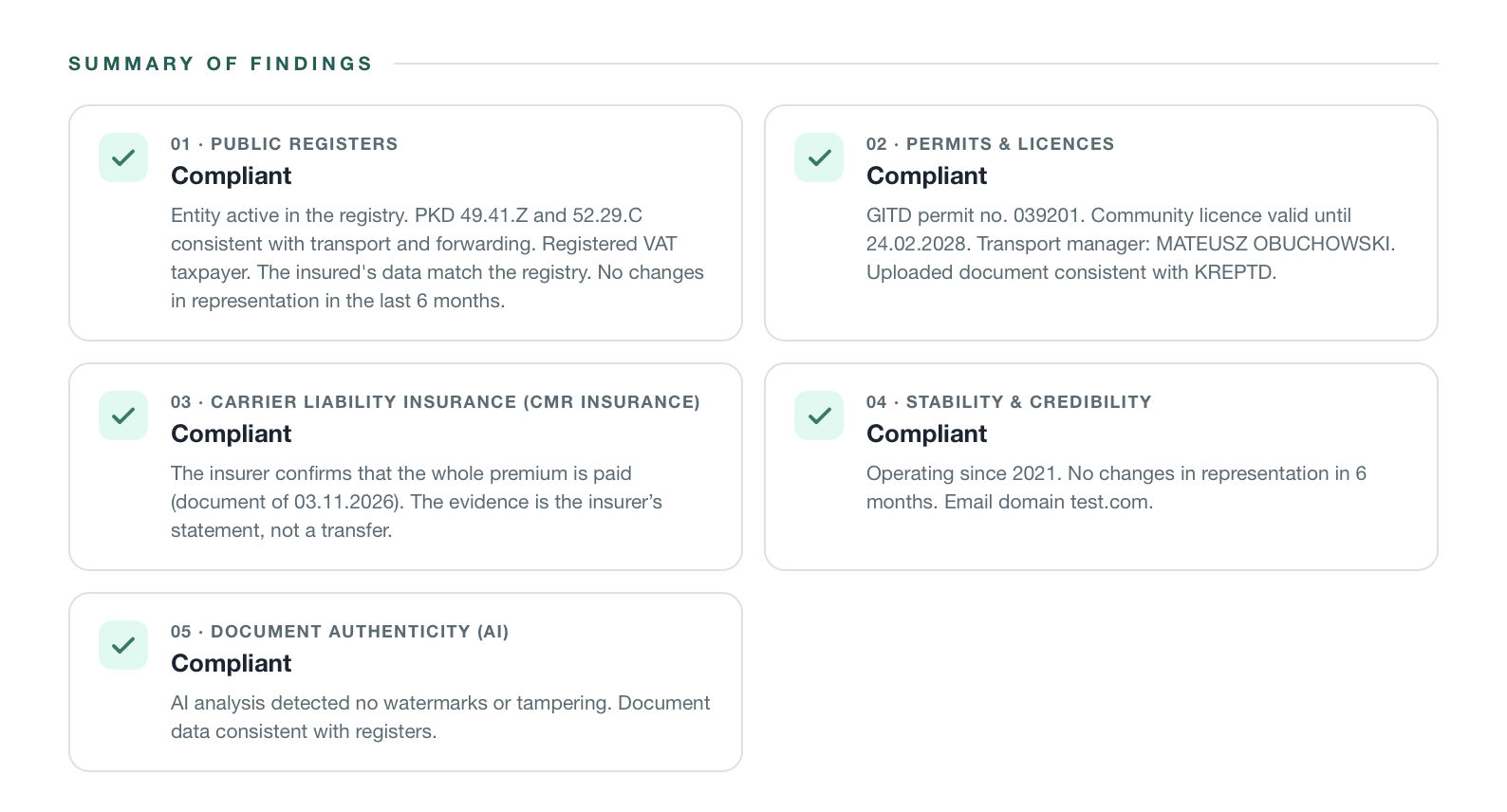
We put the report into the order file. We do not guarantee that the report will decide every claim against the insurer, because that depends on the policy terms and the circumstances of the loss. What it gives is an answer to the first question asked at that point: what was checked, and when.
Six questions when assessing a tool
It does not matter whether we say that AI "helps" or that it "verifies". What matters is whether we know what the result rests on. Before you trust any tool, ours included, ask:
- Who establishes the company data: a system that retrieves it from registries and institutions, or AI that composes an answer?
- Will the tool recognise that the carrier sent a different document from the one we asked for?
- Can it handle a document in a foreign language and show a translation next to the original?
- Does it compare the documents with each other and look for traces of alteration?
- What happens when something cannot be confirmed, and what stays in the order file after the verification?
- Did the company choose this tool, or does every forwarder use their own?
The final decision is made by a person. An OK or NOT OK result is a pointer based on registries and documents, not a verdict. The forwarder knows the carrier, the cargo and the customer. And when the wording of a policy raises doubts, they call the insurer.
AI will not make the decision for them. It will take over the copying, translating and comparing of data, the part of the job where mistakes come most easily.